

Tube Strike Triggers the Biggest Cycling Day in London

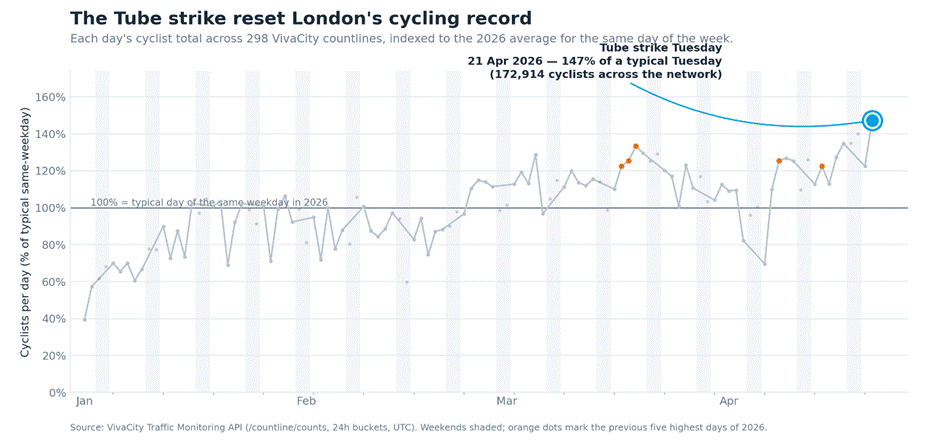
New transport data reveals that the Tuesday London Underground strike day was the biggest day of the year so far for cycling in the city.
New data released today by VivaCity, a leader in AI-powered transport data and insight, quantifies the dramatic shift in London’s commuting habits during the recent industrial action on the London Underground. Analyzing data from 99 of its AI-powered sensors across 12 London Boroughs, the study confirms that cycling volumes increased by 50% during peak hours as commuters turned to active travel to navigate the city.
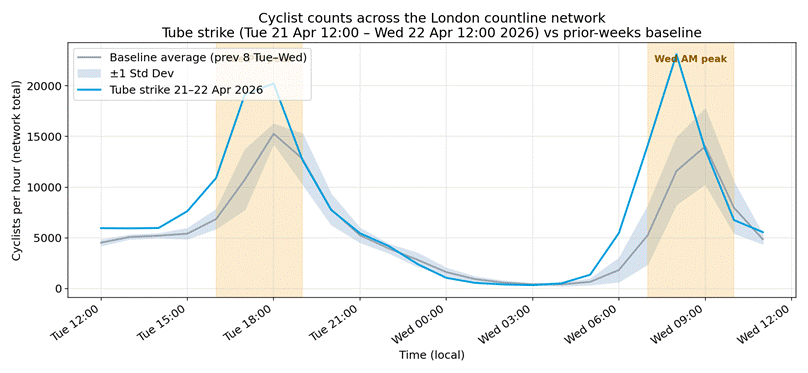
The analysis, conducted on Tuesday, 21 April and Wednesday, 22 April 2026, provides a data-backed look at the “Tube strike effect.” While social media was flooded with anecdotal reports of crowded cycle lanes, Vivacity’s sensors provided the empirical evidence: morning and evening peak hours saw more than twice the mean cyclist flow compared to the 51-week baseline.
Key Findings from the Data
- Biggest Day of the Year so Far: Tuesday 21 April is the busiest cycling day of 2026 so far, and Wednesday 22 April is on course to beat it. Strike Tuesday has a 14.6% lead over the 2nd day.
- Massive Volume Increases: Across the 99 monitored sites, peak-hour cycling flows were 50% higher than the previous 8-week average
- Central London Hotspots: One specific site capturing North-South flow in Central London recorded cycling volumes nearly four times the norm at the busiest peak hour.
- Shifted Commuting Windows: The “peaks” in the data were not only taller but wider, indicating that commuters were forced to, or chose to, travel earlier than usual to accommodate the lack of rail options.
The Strategic Importance of Measuring Active Travel
Beyond reacting to short-term disruptions, this data highlights the critical role cycling plays in the resilience of urban transport networks. As cities like London, Manchester and Liverpool increasingly lean into “active travel visions,” the ability to measure these trends accurately is becoming a cornerstone of urban planning fit for the future.
“Measuring cycling is about more than just counting bikes; it is about understanding how a city breathes. Data allows local authorities to identify where infrastructure is over-capacity and where safety improvements are most needed. As we’ve seen in our extensive work with TfL and London boroughs, data-driven insights are essential for justifying the investment needed to make roads work for all road users, not just cars.”, said Mark Nicholson, VivaCity’s CEO.
Why Cycling Matters to Modern Cities
The surge in cycling during the Tube strike highlights exactly why active travel is the backbone of a future-proof city; by boosting cycling rates, we lean into sustainability and slash the carbon footprint of the daily commute, while simultaneously tackling public health by encouraging physical activity and clearing the air of vehicle emissions. This shift is also a win for congestion management, as it takes the heavy pressure off road and rail networks during high-demand disruptions, and it significantly improves safety because, by leveraging data to track flow and behaviour, cities can deliver “Safer Cycling for All”, ensuring that infrastructure is inclusive and protects vulnerable road users.
Vivacity’s latest findings serve as a reminder that when the usual transport arteries are blocked, Londoners are ready and willing to cycle, provided the city continues to support and expand the infrastructure necessary to keep them moving.
The ITS UK Member News Service shares announcements and press releases from member organisations. The content is solely the responsibility of the issuing organisation and does not imply endorsement by ITS UK.