

Snapper Services launches interactive Mosaiq Global Public Transit Index

Snapper Services has launched an interactive Mosaiq Global Public Transit Index to help UK operators and authorities turn benchmarking into action.
UK transport authorities and operators face growing pressure to improve reliability, efficiency and passenger experience, often with limited resources and increasingly complex data environments. Yet understanding how a network is performing, and how it truly compares with peers, remains a persistent challenge.
At Interchange 26 in Manchester, Snapper Services has unveiled the interactive Mosaiq Global Public Transit Index (GPTI), a new benchmarking tool designed specifically to help public transport professionals move beyond static reports and turn comparison into confident, evidence-based decision-making.
The interactive GPTI allows users to dynamically explore global public transport performance, compare networks at multiple levels, and identify peers facing similar operational and demand challenges. The Index is built on open data from more than a thousand locations worldwide, providing an up-to-date view of network performance, and is a free resource.
“Across the UK and globally, benchmarking is often slow, manual, and disconnected from day-to-day decision-making,” said Miki Szikszai, CEO of Snapper Services. “The GPTI gives operators and authorities a clearer, more current view of performance, and, crucially, the context needed to understand what those comparisons actually mean.”

A new approach to public transport benchmarking
While benchmarking is widely recognised as valuable, many existing tools rely on static data snapshots that struggle to reflect real-world operating conditions. Data is often pulled together from multiple systems, comparisons can be difficult to validate, and insights arrive too late to influence decisions.
The interactive GPTI addresses these issues by enabling transport professionals to:
- Explore performance data dynamically rather than relying on fixed reports
- Identify genuinely comparable peer networks
- Support performance management and network planning discussions including those around franchising
- Share insights with stakeholders
Rather than focusing on league tables, the GPTI is designed to understand relative performance in context, helping teams identify where improvement efforts are likely to have the greatest operational impact.
Illustrative UK comparison: Manchester and Liverpool (over 28 days)
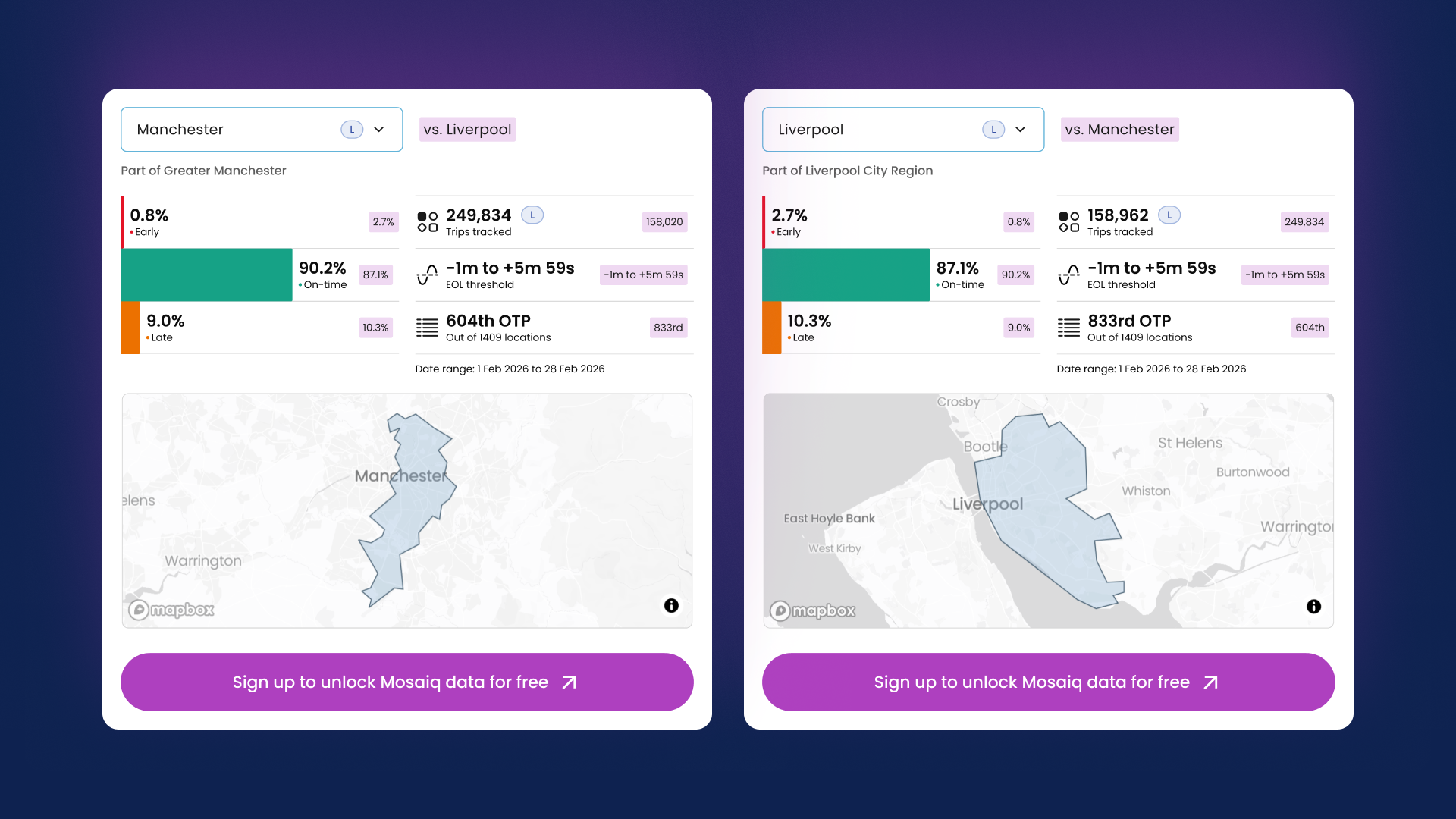
To show how the GPTI works in practice, recent data from 1 to 28 February 2026 illustrates Manchester and Liverpool’s performance. Manchester achieved a first stop on-time performance of just over 90%, placing it 16th out of 175 UK locations, while Liverpool, which scored a slightly lower on-time performance score of just over 87%, ranked 47th. This example is intended only as an illustration: the Index is dynamic, allowing users to compare any location against local or global peers and see how performance changes over time.
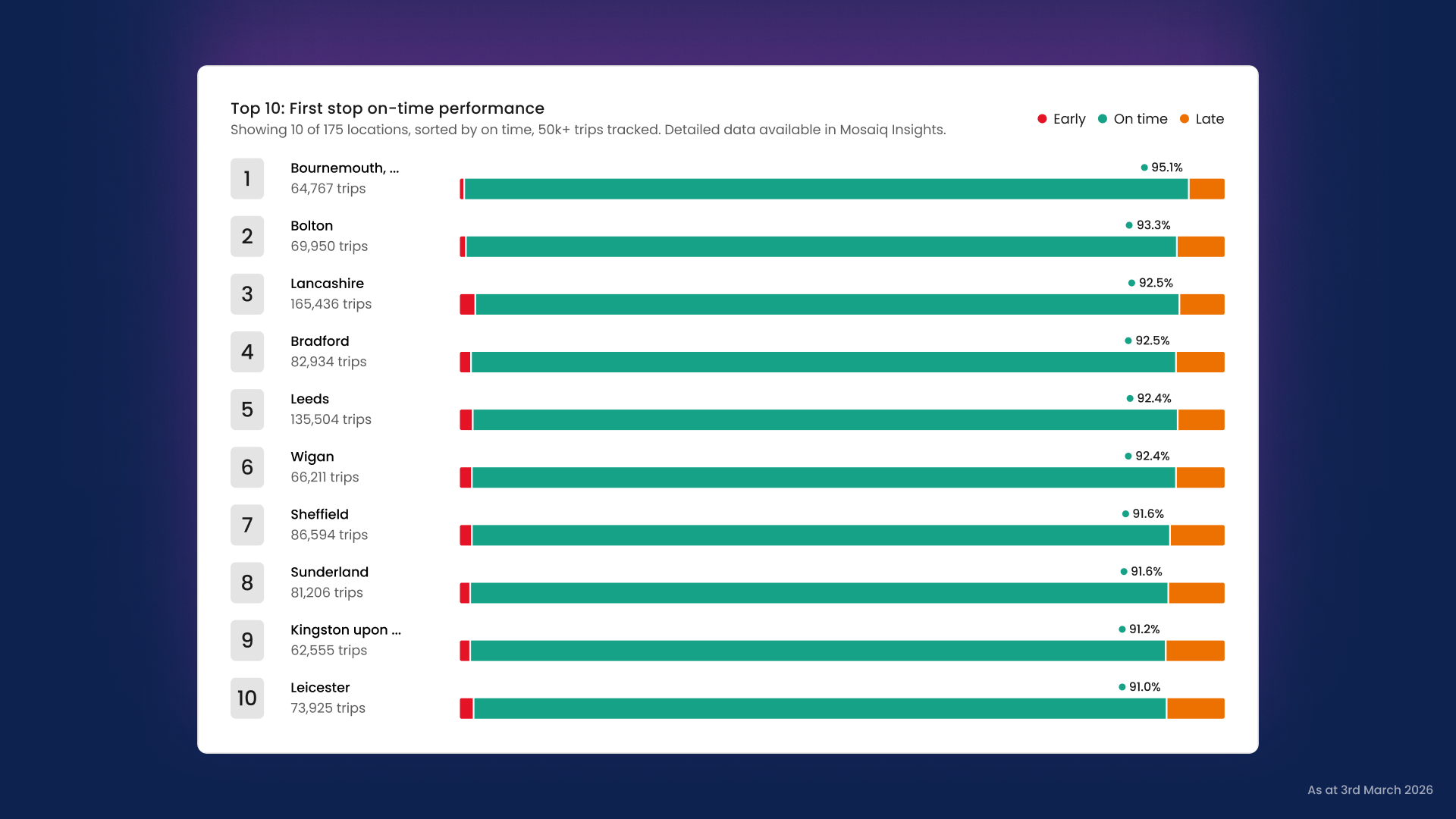
For broader context, the GPTI also highlights top-performing locations across the UK. The Spotlight on UK section of the Index lists the top 10 locations by first stop on-time performance. The top five include Bournemouth, Christchurch and Poole; Bolton; Lancashire; Bradford; and Leeds, demonstrating that high-performing networks vary widely in size and geography.
By combining illustrative examples with the broader benchmark table, the GPTI gives transport authorities a clear, flexible view of where their networks stand nationally and internationally, supporting evidence-based planning and operational improvement.
From benchmarking to operational insight
We didn’t just stop at the GPTI, we know transport operators and authorities are hungry for the detail behind the headlines, so we’ve created a free pathway into Mosaiq Insights, part of the wider Mosaiq Transit Intelligence Suite.
While the Index highlights where differences in performance exist, Mosaiq Insights enables deeper analysis of the drivers behind those differences- whether at route, time-of-day, or network-wide level, using running times, reliability metrics, and trip-level data.
This progression allows UK transport authorities and operators to move from high-level comparison to targeted, evidence-based action.
“Benchmarking should support better decisions, not just better dashboards,” Szikszai said. “By combining global comparison with operational depth, the GPTI helps teams focus on what will genuinely improve network performance.”
The ITS UK Member News Service shares announcements and press releases from member organisations. The content is solely the responsibility of the issuing organisation and does not imply endorsement by ITS UK.