

Built In, Left Out: How Intelligent Transport Can Finally Serve the Workforce That Builds It

Esther Fobi is the winner of the 2026 Allan Prize for the best essay in the Early Career category. Here, you can read her winning essay. Find out more about the competition here.
Introduction
Consider a statistic that rarely appears in any transport planning document: in 2022, the Construction Industry Training Board surveyed 3,005 construction workers across the UK about how they travel to work, the most comprehensive study of its kind. None of that data has ever been formally connected to a transport demand model, a bus timetable, or a Mobility as a Service platform(MaaS)(CITB, 2023). The workforce that builds Britain’s transport infrastructure remains, in the eyes of the transport planning system, statistically invisible.
This essay explores that gap, not as a critique of progress already being made, but as an opportunity the Intelligent Transport Systems community is uniquely placed to seize. The competition’s inclusivity theme asks how technology can ensure our transport network is safe, sustainable, and open to all. This essay argues that a compelling answer lies in directing that technology towards the construction workforce, a group whose specific travel needs have never been systematically addressed, and whose inclusion would simultaneously advance inclusivity, safety, and sustainability.
I work in this industry. A standard site day runs from 7am to 5pm, and that is before accounting for travel. For many workers, that means leaving home before 6am and returning after 6pm. A one-hour break sits within that day on paper. In practice, when programme pressures build and tasks need finishing, that break is often the first thing to quietly disappear, not through any failure of intent, but through the natural demands of a production environment (Sherratt, 2014). I have experienced this firsthand, and I have seen colleagues without access to a car navigating genuinely complex arrangements to reach sites
A Workforce the System Was Not Designed For
The UK construction industry employs approximately 2.7 million people across a wide range of roles, many of which carry no driving licence requirement(CITB, 2023). Labouring, groundwork, site support, and numerous specialist trades are all accessible without a licence, which means a meaningful portion of the construction workforce depends on others to reach sites that public transport does not serve.
Construction sites occupy an unusual position in planning law. While Active Travel England guidance sets an expectation that occupied buildings should be within 400 metres of a public transport stop, construction sites are classified as temporary workplaces and fall outside that standard (Active Travel England, 2023). The result is structural: sites are routinely located on the urban or in rural areas, operational on shift patterns that begin before the first bus runs, and subject to finish times that vary too unpredictably for fixed timetables to accommodate.
The Construction Industry Training Board’s(CITB) own research captures the consequence over time. Between 2018 and 2022, the proportion of construction workers confident they could find a future role travel-able from their permanent home fell from 84% to 69% (CITB, 2023). That declining confidence is partly a story about site locations. But it is also, at its core, a transport story, workers gradually losing faith that the network will meet them where they are.
What fills the gap is a system that functions, but only informally; the subcontractor van. Early morning collection runs, workers gathered from dispersed pickup points across a wide radius, driven to site before the working day begins. It is an entirely untracked, unoptimized logistics operation running invisibly alongside the formal transport network. Its carbon cost goes unrecorded. Its safety implications are significant and go largely unexamined. To explore whether this pattern was representative at site level, a primary survey of site personnel across three contractors was conducted, the results of which are presented below:
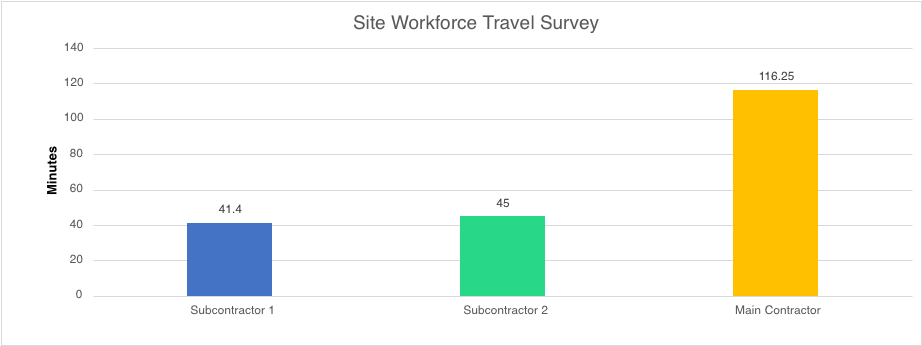
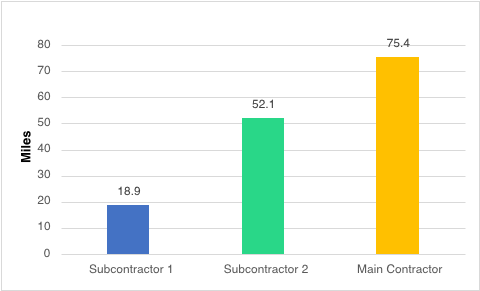
Figure 1: Average travel time (A) and travel time to site (B) by company across a site
Figure 1 illustrates a clear divide between subcontractors and the principal contractor workforce, with the principal contractor workforce travelling significantly greater distances. While subcontractors are more locally based, their average travel time still approaches an hour, highlighting that proximity does not necessarily equate to easy access. This pattern carries an important social value implication worth naming. Major construction projects routinely carry explicit commitments to local employment, scored criteria in procurement evaluations, pledges to employ people from nearby communities. These commitments are genuine. But they are quietly undermined when site access requires a car that a significant portion of the local workforce does not own. A contractor can score full marks for a local hiring pledge while the site itself filters out anyone without a driving licence.
The Fatigue Question: What the Evidence Tells Us
Understanding the transport challenge facing construction workers requires understanding what the working day actually does to the body and mind, because the commute home does not occur in isolation from the ten hours that follows after it. Research consistently demonstrates that the human brain can sustain effective cognitive concentration for between four and six hours before performance begins to measurably decline, with decision-making quality and reaction time worsening under continued physical and mental load (Mavie, 2025). A standard 7am to 5pm shift places workers well beyond that threshold before they reach their vehicles.
The situation is compounded by what happens, or more precisely, what often does not happen, within that shift. Under the Working Time Regulations 1998, workers are entitled to a twenty-minute rest break for every shift exceeding six hours. Employers are legally required to ensure workers are able to take that break, but crucially are not required to ensure they actually do so (GOV.UK, 2024). In practice, research into construction site culture has found that programme pressures lead workers to informally deprioritise rest, with breaks functioning more as a reward for output than a guaranteed period of recovery (Sherratt, 2014). A large-scale workforce study found that 29% of full-time employees frequently skip work breaks, with doing so significantly associated with fatigue and physical exhaustion across all measures studied (Tucker et al., 2021). The cumulative picture is of workers arriving at the end of a long physical shift, frequently without the rest that policy intends, and then facing a drive home with no realistic alternative.
The road safety evidence for the risk this creates is well established. The European Commission’s Road Safety Observatory identifies fatigue as a contributing factor in between 10% and 20% of road crashes, noting that a driver who has been awake for 17 consecutive hours presents a crash risk equivalent to a blood alcohol level of 0.05 (European Commission, 2024). Research published in the Proceedings of the National Academy of Sciences found measurable driving impairment in shift workers within the first fifteen minutes of a post-shift commute, with fatigue-related risk present even on short journeys home (Czeisler et al., 2015). A Cardiff University study confirmed that shift work and prolonged working hours are key factors linked to an increased likelihood of road traffic accident involvement among regular drivers (Cardiff University, 2016).
Construction workers completing a 7am to 5pm shift, often without a full break, after sustained physical work, and then driving home through rural or congested routes represent a large, identifiable population facing demonstrably elevated risk. This is a problem that better transport provision could materially address.
The Data Gap: Why the Status Quo Persists
If the need is evident, why has it gone unaddressed? The answer lies in a structural data gap. Construction workforce mobility data exists in CITB research reports, occupational health studies, and contractor HR systems, but it has never been systematically connected to transport planning. There is no national framework for translating construction project workforce data into transport demand signals. Local transport authorities receive planning applications for major projects, but those applications do not routinely require significant workforce transport assessments. The question of how thousands of workers will reach a site for two or three years is, in transport planning terms, largely unasked.
This matters because transport planning is fundamentally a data-driven discipline. Demand-responsive services, network design, and frequency decisions all depend on legible, structured demand signals. Construction workforce mobility generates exactly that kind of demand, temporary, geographically specific, and in aggregate highly predictable. The technical capability to capture and use it already exists within the ITS sector. What has been absent is the policy framework that would require it to flow.
Three Proposals for Change
1. A National Construction Workforce Mobility Data Standard
The most foundational change required is the creation of a national data standard for construction workforce mobility, a common framework requiring major projects above a defined contract value to collect and share anonymised workforce travel data with local transport authorities as a condition of planning consent or public funding.
This would give the transport planning system what it currently lacks- structured, consistent information on where workers are travelling from, by what mode, at what times, and for how long the demand will persist. Collected across regions, this data would allow authorities to identify underserved corridors, design responsive services around actual shift patterns, and build the evidence base for permanent network improvements in areas that construction activity is opening up.
The criterion exists in adjacent policy areas. Environmental impact assessments already require standardised data collection as a condition of development consent, and transport assessments are required for major planning applications. Extending this logic to workforce mobility data is a measured, proportionate step, one that asks not for immediate infrastructure investment, but for the information that would make investment decisions significantly more effective.
2. Smart Sensors and Demand-Responsive Transit
Once a data standard is established, the next layer is making that data operational in real time. Smart sensors at site access and egress points, access control technology that already exists on most major sites for safety and welfare monitoring, can generate live data on workforce movement: when shifts are ending, how many workers are leaving, and in which directions they are travelling. Fed into a transport operations platform, this data can trigger demand-responsive services with the precision and timing that fixed timetables cannot offer.
The Edinburgh and South East Scotland City Region Deal offers a real-world precedent. Its Workforce Mobility Project, the first of its kind in Scotland, trialled demand-responsive transport explicitly linked to employment site activity, with services adapting to actual workforce movements rather than assumed patterns (Transport Scotland, 2024). The model is transferable: when sensors register a shift ending, a demand-responsive vehicle is dispatched to serve the primary travel corridors that the data standard has already identified. Workers who previously depended on informal arrangements have a planned, reliable alternative. Demand-responsive transit platforms already operate across rural and urban areas, the innovation required is integration with site-level data, not new vehicles or new infrastructure.
3. Procurement Reform: Site Transport Plans as a Scored Social Value Criterion
Technology and data standards will scale only if there is commercial incentive pulling them forward. The most direct mechanism to create that incentive is reform to how public construction contracts are evaluated. Under the Public Services (Social Value) Act 2012 and the Cabinet Office Social Value Model, major public contracts are already assessed on workforce welfare, local employment, and community benefit. Site transport plans do not currently feature as a scored criterion within those evaluations. Introducing them as one would change the calculation for every contractor bidding on public work.
A requirement to submit a quantified site transport plan, covering shift-pattern connectivity, modal alternatives to the private car, and genuine accessibility for workers without driving licences, would create the commercial incentive that unlocks private sector innovation. Contractors would need credible answers to transport questions they are not currently asked, and that demand would pull MaaS providers, sensor technology companies, and transport operators towards a problem they have not yet been systematically invited to solve. Crucially, it would also close the gap between social value commitments and social value delivery, ensuring that local employment pledges are supported by transport arrangements that make them genuinely realisable in practice.
Conclusion
The ITS sector’s commitment to inclusive, sustainable mobility is reflected in competitions like this one, and in the genuine belief that transport design should respond to the full complexity of human need. This essay has tried to contribute to that ambition by identifying a constituency that inclusive transport frameworks have not yet fully reached.
The construction workforce is large, diverse, and currently underserved by a system that was not built around their working patterns. The evidence presented here, on shift length, missed rest breaks, cumulative fatigue and road safety risk, and the structural invisibility of these workers in transport data, points towards a clear and solvable problem. The tools to address it already sit within the ITS sector: smart sensor networks, demand-responsive transit platforms, data standards architecture, and procurement frameworks that can create market incentives where policy alone falls short. The Edinburgh trial has shown the model works. The CITB has shown the data can be collected. What is needed is the connecting framework that brings these elements together.
Every morning, workers who laid the track, poured the concrete, and wired the stations of our transport network begin a working day that the network itself was not designed to accommodate. Finding a way to serve them better is not a secondary concern for inclusive transport policy. It is a genuine opportunity for the ITS sector to demonstrate the full breadth of what intelligent, data-driven mobility design can achieve, and who it can reach when it is asked to look somewhere new.
References
- Active Travel England (2023) Guidance on bus stop accessibility and active travel infrastructure. Available at: https://www.activetravelengland.gov.uk/planning-active-places/bus-stops (Accessed: 12 March 2026).
- Cardiff University (2016) A UK survey of driving behaviour, fatigue, risk taking and road traffic accidents. BMC Public Health, 16(1). Available at: https://pmc.ncbi.nlm.nih.gov/articles/PMC5013464/ (Accessed: 14 March 2026).
- CITB (2023) Workforce Mobility and Skills in the UK Construction Sector 2022. Prepared by BMG Research. Bircham Newton: Construction Industry Training Board Available at: https://www.citb.co.uk/about-citb/construction-industry-research-reports/search-our-construction-industry-research-reports/workforce-mobility-and-skills-in-the-uk-construction-sector-2022/ (Accessed: 10 March 2026).
- Czeisler, C.A. et al. (2015) High risk of near-crash driving events following night-shift work. Proceedings of the National Academy of Sciences, 112(38), pp. 11817-11822. Available at: https://www.pnas.org/doi/10.1073/pnas.1510383112 (Accessed: 15 March 2026).
- European Commission Road Safety Observatory (2024) Fatigue: statistics and analysis. Available at: Available at: https://road-safety.transport.ec.europa.eu/european-road-safety-observatory/statistics-and-analysis-archive/fatigue/fatigue_en (Accessed: 14 March 2026).
- GOV.UK (2024) Rest breaks at work. Available at: https://www.gov.uk/rest-breaks-work (Accessed: 13 March 2026).
- Mavie (2025) How long can humans concentrate? Available at: https://www.mavie.care/en-AT/blog/blog-post-how-long-can-humans-concentrate (Accessed: 13 March 2026).
- Public Services (Social Value) Act 2012. Available at: https://www.legislation.gov.uk/ukpga/2012/3 (Accessed: 16 March 2026).
- Sherratt, F. (2014) Exploring zero target health and safety management in the UK construction industry. Construction Management and Economics, 32(7-8), pp. 737-748
- . https://ideas.repec.org/a/taf/conmgt/v32y2014i7-8p737-748.html
- Transport Scotland (2024) Edinburgh and South East Scotland City Region Deal: Workforce Mobility Project evaluation. Available at: (Accessed: 16 March 2026).
- Tucker, P. et al. (2021) Work breaks and well-being: the effect of autonomy-supportive supervision. Work and Stress, 35(3), pp. 243-260. Available at : https://pubmed.ncbi.nlm.nih.gov/25479980/ (Accessed:14 March 2026)
- Working Time Regulations 1998 (SI 1998/1833). Available at: https://www.legislation.gov.uk/uksi/1998/1833/contents (Accessed: 13 March 2026).